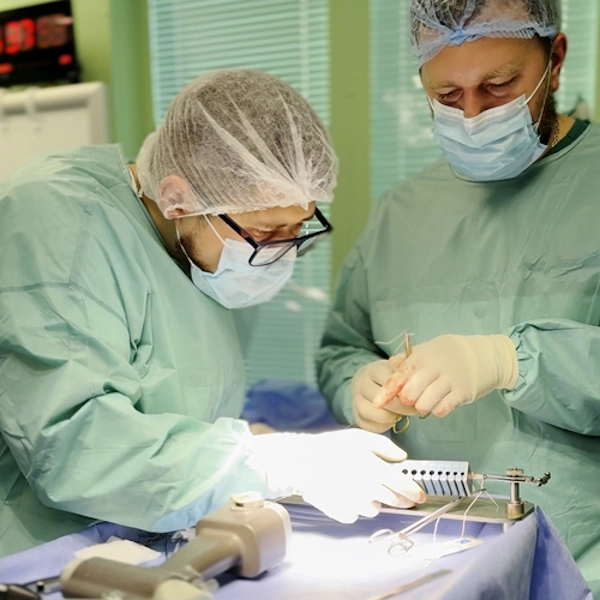
Full range of orthopedic services from diagnosis to rehabilitation. We provide assistance with injuries and diseases of the joints, as well as sports injuries.
HILT is a physical therapy method in which tissues are exposed to high-power laser radiation. Light energy is absorbed by the tissues, and the way it interacts with them depends on the wavelength, power, operating mode of the device, duration of exposure, and properties of the tissue itself.
#foot
#knee
#back
Knee Osteoarthritis: HILT
In the early stages, pain is often associated with physical load and improves with rest. A person may notice discomfort after a long walk, physical work, or exercise, even though the same level of activity previously caused no problems.
#knee
Disc Protrusion: Can It Be Treated Without Surgery?
Spinal disc protrusion can cause pain, numbness, and weakness in the limbs. Learn about diagnosis, non-surgical treatment, and rehabilitation.
#back
Herniated Disc: Symptoms, Causes, and Treatment Options
A herniated disc is a localized displacement of disc tissue beyond its normal anatomical boundaries.
#back
Rehabilitation After Arthroscopy: What You Need to Know
After joint arthroscopy, it is necessary to restore movement, weight-bearing ability, muscle strength, and the capacity to tolerate everyday activity.
#hand
#knee
#elbow
#shoulder
#foot
Shoulder and Arm Pain: Causes and Treatment
The shoulder has a wide range of motion, which makes it particularly sensitive to injuries, overuse, and inflammatory changes.
#shoulder
Intra-Articular Injections: Indications and Risks
Intra-articular injections are a common treatment option for joint pain. They may provide relatively rapid relief, improve mobility, and help a person return to everyday activities.
#knee
#shoulder
#thigh
Ankylosing Spondylitis: What It Is, Symptoms, and Diagnosis
Ankylosing spondylitis, also known as Bechterew’s disease, is a chronic inflammatory condition that affects the spine and sacroiliac joints. Over time, it can limit mobility and significantly affect quality of life.
#back
Osteoarthritis of the Joints: Symptoms, Causes, and Treatment
Osteoarthritis is a chronic disease of the entire joint in which the articular cartilage gradually deteriorates, bone tissue changes, and the surrounding joint structures function less effectively.
#hand
#knee
#elbow
#shoulder
#thigh
Rheumatoid Arthritis: Symptoms and Rheumatoid Factor
Rheumatoid arthritis is a systemic autoimmune inflammatory disease that affects the joints, tendon sheaths, and other tissues throughout the body.
#hand
De Quervain’s Disease: Symptoms and Treatment Methods
De Quervain’s disease, also known as De Quervain’s tenosynovitis, is a condition affecting the first extensor compartment of the wrist. The thumb tendons pass through a narrowed tunnel and begin to glide with pain.
#hand
Hygroma: Causes and Effective Treatment
A hygroma is a superficial, bony formation near a joint or tendon canal that most often appears on the hand, wrist, or fingers.
#hand
Trigger Finger (Stenosing Tenosynovitis)
Stenosing ligamentitis disrupts the normal gliding of the finger tendon and gradually makes the usual hand movements more difficult. At first, a person feels stiffness, then a painful clicking appears, and at later stages the finger becomes fixed in a bent position.
#hand
Why Does a Finger Hurt: Main Causes and Treatment
Pain in the finger appears after injury, overload, inflammation or compression of the nerve. The symptom itself does not indicate one specific problem, because the source of discomfort can be a joint, tendons, ligaments, nerve or surrounding soft tissues.
#hand
Joint Contracture: Causes, Symptoms, Types, and Treatment Methods
Joint contracture is a persistent decrease in range of motion due to changes in the soft tissues and other structures around the joint. This condition interferes with everyday activities and can significantly worsen quality of life.
#hand
Can You Run with Osteoarthritis?
When running with arthrosis is possible, in which cases it is strictly not recommended, and what alternatives should be considered in order to maintain movement without harm to the joints - says Vasily Mellen, orthopedic surgeon and traumatologist of Mashtaler Ortho&Trauma Clinic.
#knee
What Are Compression Stockings?
When people think about treatment of the musculoskeletal system, they usually imagine surgery, fixation, and exercise. However, there is another component that works almost unnoticed while significantly affecting the recovery process: compression stockings.
#foot
#knee
Rehabilitation and Life After Hip Replacement
The pain that caused sleepless nights, restricted movement, and changed daily habits disappears. In the first days after surgery, patients notice that it becomes easier to stand up and sit down. It is a relief to stop thinking about every step.
#thigh
Innovative Bikini Approach for Hip Replacement Surgery
Bikini approach is a relatively new, minimally invasive method that is distinguished by its delicacy, less trauma and expressive aesthetics.
#thigh
Donor Meniscus Transplantation
This is an important milestone, as the procedure has been performed only eight times in Ukraine.
No items found.
Anterior Cruciate Ligament (ACL) Tear
The anterior cruciate ligament connects the femur and the tibia, helping stabilize the knee during bending, pivoting, and walking.
#knee
Super Inductive System
Super Inductive System (also known as High-Intensity Magnetotherapy) is a modern, effective, and safe method of pain treatment that works without invasive intervention.
The anterior cruciate ligament (ACL) is one of the primary stabilizing ligaments of the knee. It helps stabilize the knee during movement and is most commonly injured in active individuals, including athletes, military personnel, and adolescents. Such an injury requires accurate diagnosis and appropriate treatment. At Mashtaler Ortho&Trauma, we follow evidence-based treatment protocols to restore knee stability and function.
What Is the Anterior Cruciate Ligament and Why Is It Important?
The anterior cruciate ligament connects the femur and the tibia, helping stabilize the knee during bending, pivoting, and walking. It runs diagonally through the center of the knee joint and, together with the posterior cruciate ligament, forms the characteristic "cross" that gives these ligaments their name.
The ACL prevents excessive forward movement (anterior translation) of the tibia, particularly during weight-bearing activities and sudden changes in direction. According to the American Academy of Orthopaedic Surgeons (AAOS), the ACL provides more than 85% of the restraint against anterior translation of the tibia.
ACL tears are among the most common injuries in sports medicine. More than 100,000 ACL reconstruction procedures are performed annually in the United States. They are also one of the most common reasons young patients seek orthopedic care, as confirmed by our clinical experience at Mashtaler Ortho&Trauma.
What Causes an Anterior Cruciate Ligament Tear?
An ACL tear occurs when the force applied to the ligament exceeds its structural strength. The injury mechanism is usually sudden and involves uncontrolled foot movement, twisting, direct impact, or a fall.
Sports Injuries
ACL tears most commonly occur during sports involving rapid changes of direction, such as football, basketball, or skiing. A typical injury occurs during a sudden stop or pivot while the foot remains planted. In many cases, no direct impact is involved. Instead, the ligament tears because of an awkward landing or a sudden change in direction combined with rotational force.
Everyday and Road Traffic Injuries
Not all ACL injuries are sports-related. We also diagnose ACL tears after falls on stairs, slips on ice, or dashboard injuries sustained during road traffic accidents. Such trauma may damage not only the ACL but also the meniscus or the articular cartilage.
Sudden Stops and Twisting Movements
A classic mechanism of ACL injury is a sudden stop or rapid change in direction while the foot is firmly planted and the body continues to rotate. This may occur not only during sports but also in everyday situations, such as dancing, jogging, or climbing stairs.
Anatomical and Physiological Risk Factors
In addition to external causes, several internal factors increase the risk of ACL injury:
a greater Q-angle (more common in women);
a narrow intercondylar notch of the femur;
weakness of the hip muscles or inadequate rehabilitation after previous injuries;
hormonal influences.
The risk of ACL tears is estimated to be four to six times higher in women than in men. A considerable proportion of repeat injuries is also associated with inadequate rehabilitation after previous lower-limb injuries, making proper rehabilitation one of the key factors in preventing re-injury.
What Are the Symptoms of an ACL Tear?
ACL injuries usually present with a characteristic set of symptoms. At Mashtaler Ortho&Trauma, we observe a similar clinical pattern in the vast majority of patients with acute ACL tears. These signs often help distinguish an ACL tear from other knee injuries even before MRI is performed.
Acute Pain and a "Popping" Sound
Patients often describe sudden severe pain accompanied by a distinct popping sound or sensation inside the knee at the moment of injury. This occurs when the ligament tears.
Many patients describe the sensation as "something snapped" or "something tore inside my knee." This is one of the characteristic signs of an acute ACL tear.
Knee Swelling During the First Hours
Following injury, bleeding into the joint (hemarthrosis) usually develops rapidly. Significant swelling often appears within 2–4 hours.
Rapid swelling usually indicates substantial internal injury, commonly involving the ACL together with damage to the meniscus or cartilage. In our experience, pronounced hemarthrosis frequently accompanies complete ACL tears.
A Feeling of Knee Instability or "Giving Way"
Patients often report that "the knee gives way," "it feels unstable," or "I can't trust my leg." These symptoms reflect mechanical instability caused by loss of one of the knee's primary stabilizing structures—the ACL.
Continuing to walk or return to normal activities despite this instability increases the risk of further injury, particularly damage to the meniscus.
Restricted Motion and Pain During Weight-Bearing
Swelling and pain reduce the knee's range of motion. Attempts to fully bend or straighten the leg usually cause significant discomfort, especially while bearing weight.
During the first 12 hours after injury, many patients are unable to bear weight normally. The knee may feel locked or unstable.
How Can an ACL Tear Be Distinguished from Other Knee Injuries?
A definitive diagnosis can only be made by a physician. However, several features are particularly suggestive of an ACL tear rather than other knee injuries.
Type of injury
Typical Signs
Anterior cruciate ligament (ACL) tear
Sudden pain, a popping sound, rapid swelling (within 1–3 hours), and a feeling that the knee gives way
Meniscal injury
Pain during knee flexion, locking of the knee, limited extension
Collateral ligament sprain
Pain on one side of the knee without a popping sensation or hemarthrosis
For clinical evaluation, orthopedic specialists commonly perform:
the Lachman test;
the Anterior Drawer Test;
the Pivot Shift Test.
When severe swelling is absent, these tests have an accuracy exceeding 80%. Combined with MRI findings and the patient's history, they provide excellent diagnostic accuracy.
What Should You Do If You Suspect an ACL Tear?
Following a knee injury with symptoms suggestive of an ACL tear, it is important to follow the RICE protocol until medical evaluation:
Rest — stop weight-bearing activities and stabilize the knee.
Ice — apply an ice pack or cold compress for 15–20 minutes every 1–2 hours.
Compression — use an elastic bandage to reduce swelling.
Elevation — keep the leg elevated above heart level to reduce swelling.
If necessary, anti-inflammatory medications such as ibuprofen or diclofenac may help relieve pain and inflammation. However, patients should avoid attempting to continue walking or returning to activity, as this may worsen the injury.
When Should You See a Doctor Without Delay?
Not every knee injury requires immediate surgery, but every significant injury requires an accurate diagnosis. Medical evaluation should not be delayed if:
you heard a popping sound or felt a snap at the time of injury;
the knee became swollen within four hours;
the knee feels unstable or cannot support your weight;
knee movement became significantly restricted;
the knee locks or catches during movement.
Some patients seek treatment only two or three weeks after injury. By that time, additional problems—particularly meniscal injuries—may already have developed, making treatment more complicated and increasing the likelihood of surgery.
How Is an ACL Tear Diagnosed?
Evaluation at Mashtaler Ortho&Trauma includes several stages.
Medical history. We assess the injury mechanism, the presence of a popping sensation, swelling, the patient's age, and activity level.
Physical examination. Clinical tests, including the Lachman Test, Pivot Shift Test, and Anterior Drawer Test, are performed whenever swelling allows reliable assessment.
Imaging. If necessary, additional imaging studies are requested. X-rays help exclude fractures of the femur or tibia, while MRI demonstrates the ACL tear itself as well as associated injuries involving the meniscus, cartilage, and bone bruising.
MRI also shows whether the tear is partial or complete and whether the torn ligament has retracted, information that is essential for treatment planning.
How Is an ACL Tear Treated?
Treatment depends on whether the tear is partial or complete, as well as the patient's age, activity level, and degree of knee instability. At Mashtaler Ortho&Trauma, every treatment plan is individualized.
Conservative (Non-Surgical) Treatment
Partial ACL tears or patients with lower activity demands may be treated conservatively. Treatment may include:
a custom-fitted knee brace;
temporary reduction of physical activity;
a physical therapy program focused on strengthening the thigh and lower-leg muscles;
anti-inflammatory treatment.
Patients without clinical instability often return to normal daily activities after approximately six weeks of rehabilitation. Before returning to sports, a follow-up examination is recommended to exclude residual instability.
Surgical Treatment
For complete ACL tears, especially in young or physically active patients, ACL reconstruction is considered the gold standard.
At Mashtaler Ortho&Trauma, we perform arthroscopic ACL reconstruction using an autograft harvested from the semitendinosus tendon or quadriceps tendon. If graft harvesting is not appropriate or contraindicated, a donor tendon (allograft) may be used.
The operation is performed under regional anesthesia with sedation, lasts approximately 60 minutes, and patients are usually able to get out of bed with a knee brace a few hours later.
Rehabilitation After Surgery
Rehabilitation is one of the most important stages of recovery.
Our rehabilitation program includes:
0–2 weeks: pain and swelling control, gradual restoration of range of motion;
2–6 weeks: knee stabilization and isometric strengthening exercises;
after 6 weeks: progressive strength training and coordination exercises;
after 4–6 months: gradual return to sports and an active lifestyle under medical supervision.
Can the ACL Be Fully Restored?
In most cases, yes—provided that the patient follows the recommended rehabilitation program.
However, successful ligament reconstruction alone does not guarantee a safe return to sport. Before returning to high-level activity, we assess muscle strength, balance, and knee stability. Without adequate rehabilitation, the risk of re-injury increases two- to threefold.
Most patients return to an active lifestyle within 9–12 months after injury, while professional athletes return to competitive sports only after successfully completing functional testing.
If You Experience Knee Pain or Instability After an Injury, Contact Us
An ACL injury is not only painful—it also affects knee stability and movement control. Do not wait until instability causes further damage to the cartilage or meniscus.
At Mashtaler Ortho&Trauma, we provide comprehensive care, including:
clinical diagnosis;
conservative or surgical treatment;
rehabilitation under the supervision of experienced specialists.
Schedule a consultation by phone or submit a request through our website. Early treatment offers the best chance for a faster recovery and better long-term outcomes.

.png)