Full range of orthopedic services from diagnosis to rehabilitation. We provide assistance with injuries and diseases of the joints, as well as sports injuries.
Rehabilitation After Arthroscopy: What You Need to Know
After joint arthroscopy, it is necessary to restore movement, weight-bearing ability, muscle strength, and the capacity to tolerate everyday activity.
#hand
#knee
#elbow
#shoulder
#foot
Shoulder and Arm Pain: Causes and Treatment
The shoulder has a wide range of motion, which makes it particularly sensitive to injuries, overuse, and inflammatory changes.
#shoulder
Intra-Articular Injections: Indications and Risks
Intra-articular injections are a common treatment option for joint pain. They may provide relatively rapid relief, improve mobility, and help a person return to everyday activities.
#knee
#shoulder
#thigh
Ankylosing Spondylitis: What It Is, Symptoms, and Diagnosis
Ankylosing spondylitis, also known as Bechterew’s disease, is a chronic inflammatory condition that affects the spine and sacroiliac joints. Over time, it can limit mobility and significantly affect quality of life.
#back
Osteoarthritis of the Joints: Symptoms, Causes, and Treatment
Osteoarthritis is a chronic disease of the entire joint in which the articular cartilage gradually deteriorates, bone tissue changes, and the surrounding joint structures function less effectively.
#hand
#knee
#elbow
#shoulder
#thigh
Rheumatoid Arthritis: Symptoms and Rheumatoid Factor
Rheumatoid arthritis is a systemic autoimmune inflammatory disease that affects the joints, tendon sheaths, and other tissues throughout the body.
#hand
De Quervain’s Disease: Symptoms and Treatment Methods
De Quervain’s disease, also known as De Quervain’s tenosynovitis, is a condition affecting the first extensor compartment of the wrist. The thumb tendons pass through a narrowed tunnel and begin to glide with pain.
#hand
Hygroma: Causes and Effective Treatment
A hygroma is a superficial, bony formation near a joint or tendon canal that most often appears on the hand, wrist, or fingers.
#hand
Trigger Finger (Stenosing Tenosynovitis)
Stenosing ligamentitis disrupts the normal gliding of the finger tendon and gradually makes the usual hand movements more difficult. At first, a person feels stiffness, then a painful clicking appears, and at later stages the finger becomes fixed in a bent position.
#hand
Why Does a Finger Hurt: Main Causes and Treatment
Pain in the finger appears after injury, overload, inflammation or compression of the nerve. The symptom itself does not indicate one specific problem, because the source of discomfort can be a joint, tendons, ligaments, nerve or surrounding soft tissues.
#hand
Joint Contracture: Causes, Symptoms, Types, and Treatment Methods
Joint contracture is a persistent decrease in range of motion due to changes in the soft tissues and other structures around the joint. This condition interferes with everyday activities and can significantly worsen quality of life.
#hand
Can You Run with Osteoarthritis?
When running with arthrosis is possible, in which cases it is strictly not recommended, and what alternatives should be considered in order to maintain movement without harm to the joints - says Vasily Mellen, orthopedic surgeon and traumatologist of Mashtaler Ortho&Trauma Clinic.
#knee
What Are Compression Stockings?
When people think about treatment of the musculoskeletal system, they usually imagine surgery, fixation, and exercise. However, there is another component that works almost unnoticed while significantly affecting the recovery process: compression stockings.
#foot
#knee
Rehabilitation and Life After Hip Replacement
The pain that caused sleepless nights, restricted movement, and changed daily habits disappears. In the first days after surgery, patients notice that it becomes easier to stand up and sit down. It is a relief to stop thinking about every step.
#thigh
Innovative Bikini Approach for Hip Replacement Surgery
Bikini approach is a relatively new, minimally invasive method that is distinguished by its delicacy, less trauma and expressive aesthetics.
#thigh
Donor Meniscus Transplantation
This is an important milestone, as the procedure has been performed only eight times in Ukraine.
No items found.
Anterior Cruciate Ligament (ACL) Tear
The anterior cruciate ligament connects the femur and the tibia, helping stabilize the knee during bending, pivoting, and walking.
#knee
Super Inductive System
Super Inductive System (also known as High-Intensity Magnetotherapy) is a modern, effective, and safe method of pain treatment that works without invasive intervention.
Joint contracture is a persistent decrease in range of motion due to changes in the soft tissues and other structures around the joint. This condition interferes with everyday activities and can significantly worsen quality of life.
In this article, we will explain what joint contracture is, how to distinguish it from other problems, when further diagnostic evaluation is needed, and which treatment methods are used.
What Is Joint Contracture?
In simple terms, contracture is a condition in which a joint cannot fully bend or straighten. Most often, the cause lies in pathological changes in the tissues: the capsule, ligaments, tendons, fascia, skin, and sometimes even the intra-articular structures.
In medical practice, contractures are considered to develop when elastic soft tissues are replaced by stiffer ones, and this leads to chronic loss of mobility.
Contractures may result from various pathological changes: trauma, inflammation, prolonged immobilization, neurological disorders, and degenerative processes. Regardless of their nature, they require diagnosis and treatment. The earlier recovery begins, the easier it is to restore joint function without radical interventions.
How Is Contracture Different from Ankylosis?
Both problems have similar manifestations — stiffness and reduced range of motion in the joint. However, their mechanisms differ:
Contracture is mainly associated with changes in the soft tissues and their shortening.
Ankylosis is restriction of movement due to fibrosis or even fusion within the joint.
What Types of Joint Contractures Are There?
Joint contracture is a broad group of conditions that are similar in symptoms but differ in origin and course. To choose the correct treatment method, it is first necessary to establish an accurate diagnosis. Below is the classification.
By Mechanism of Development
The causes of this condition are divided into:
muscular (myogenic) — shortening or spasm of the muscles;
articular (arthrogenic) — changes in the capsule, cartilage, and intra-articular structures;
scar-related or cutaneous (dermatogenic) — tightening of the skin after burns, wounds, or surgeries;
neural (neurogenic) — muscle tone, spasticity, impaired movement control after damage to the nervous system.
There are also contractures of combined origin, when several structures affect the limitation at the same time.
By the Nature of Motion Limitation
A flexion contracture is when the joint is fixed in a bent position and cannot fully straighten. An extension contracture is when the limb is straightened and cannot bend to a sufficient degree.
By Course
Acute conditions are those in which changes occur suddenly, for example after trauma or inflammation. They require early examination and correction. The earlier help is provided, the lower the chance that the problem will become fixed.
Chronic joint contracture is a persistent disorder that is maintained for months or years. It creates additional risks of secondary problems — improper loading of the muscles, wear of the joint structures, and pain.
Main Causes and Origin of Contracture
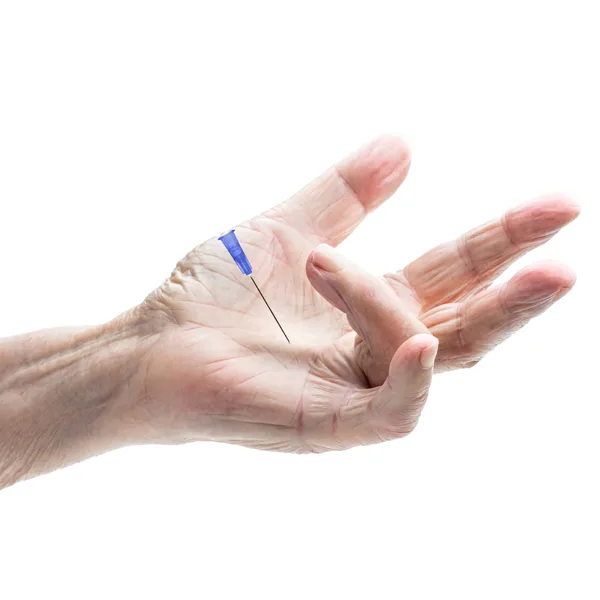
Needle aponeurotomy procedure for the treatment of hand contracture
Contractures usually arise in the following scenarios:
immobilization after fractures and injuries (a cast, orthosis, forced rest);
postoperative changes and tissue scarring;
chronic inflammation in arthritis or the consequences of joint overload;
neurological conditions with spasticity or weakness;
burns and skin damage in the joint area.
A separate example is the hand. There, pathological changes may develop due to tendon or connective tissue diseases, such as palmar fibromatosis, as well as after finger injuries.
Symptoms of Joint Contracture
The key signs are:
reduced range of motion without improvement over time;
a feeling of tightness in the muscles or surrounding tissues;
pain when trying to straighten or bend the limb;
limited mobility after sleep or prolonged static posture;
a visible change in the position of the joint or fingers.
How Does Contracture Affect Daily Activity?
Patients usually seek medical attention when the contracture begins to interfere with daily life. It becomes harder to get dressed, work with the hands, climb stairs, or keep balance. If a joint does not straighten, the body changes its movement pattern, and this leads to overload of other areas: the back, pelvis, and the healthy limb.
It looks like a vicious circle:
Less movement because of stiffness.
Less loading.
Lower tissue elasticity.
More stiffness.
Even fewer movements.
Risk Factors for the Development of Contracture
The exact causes of joint contracture are not always known. However, science identifies the following factors that increase the risk of developing this condition:
age and decreased tissue elasticity;
repeated injuries to the same joint;
arthrosis;
work involving repetitive loading of one muscle group;
periods of forced reduced mobility after surgery, stroke, or prolonged pain.
Possible Complications
Without medical care, the problem may worsen and lead to the following consequences:
increased deformity and permanent loss of joint function;
chronic pain and changes in gait or posture;
overload of the ligaments and tendons;
decreased muscle strength due to forced restriction of activity;
psychological changes caused by giving up one’s usual lifestyle.
Diagnosis of the Condition
As soon as symptoms appear, you should consult a doctor in order to assess the changes — their nature, extent, and impact on the surrounding structures.
Diagnosis usually includes:
collecting medical history and assessing complaints;
examination, measuring joint range of motion, and tests for muscle elasticity
assessment of pain, sensitivity, strength, and tendon function;
if necessary, instrumental methods and other examinations to clarify the causes of the changes.
This makes it possible to choose the optimal treatment strategy for a specific patient.
Methods of Treating Joint Contracture
At the Mashtaler Ortho&Trauma center, preference is given to conservative and minimally invasive methods — they are easier for patients to tolerate, are associated with fewer complications, and involve a shorter rehabilitation period. However, in cases of persistent disorders, we recommend surgical intervention, which makes it possible to achieve greater effectiveness and a lower risk of recurrence in these cases.
Conservative Treatment
Physical and medication-based therapy are used to restore movement:
graded stretching;
strengthening and increasing muscle elasticity;
load control;
therapeutic exercise and massage;
anti-inflammatory medication, when indicated.
In complicated cases, parallel treatment of arthrosis may be required. Such a comprehensive approach increases effectiveness and reduces the likelihood of recurrence.
For the hand and fingers, static progressive and dynamic splints are often considered effective non-surgical methods.
Orthopedic Methods
If the joints already maintain an incorrect position persistently, orthoses, splints, and night braces may be used. They are applied both during treatment and during rehabilitation in order to maintain the result and reduce the likelihood of regression.
Surgical Treatment
If the contracture has been present for a long time or there are severe structural disorders, surgical intervention is considered. This is relevant when conservative methods do not produce progress, the restriction of movement increases, or the limb becomes fixed in a forced position.
In modern practice, the following approaches are used:
arthrolysis — releasing the joint from scar adhesions and blocks in order to restore range of motion;
capsulotomy — cutting or releasing a dense joint capsule when it has contracted;
tenolysis — releasing tendons from scar adhesions if they glide poorly;
fasciotomy or fasciectomy — removal of pathologically changed fascia in certain types of contracture;
corrective procedures on soft tissues and ligaments if they are the structures holding the joint in an incorrect position.
After surgery, staged mobilization, orthoses, or serial casting are often used in order to maintain the result and preserve the achieved mobility.
For the hand, there are specific solutions, including minimally invasive treatment of Dupuytren’s contracture, or palmar fibromatosis. Needling, or needle aponeurotomy, reduces tissue trauma and makes rehabilitation easier. However, it has its limitations, so surgical treatment with removal of pathological cords continues to be used in complex cases.
Rehabilitation After Treatment and Restoration of Mobility
The main goal after the active stage of treatment is to preserve the achieved range of motion and restore control of movement. During the first 1–2 weeks, the main focus is on gentle restoration of movement without jerks, so that the joint gets used to working within a new range. Then exercises for coordination and precision are added, especially when the hand and fingers are involved. At 3–6 weeks, strength loading is gradually introduced so that the muscles once again stabilize the joint and there is no sensation of weakness during everyday tasks.
Rehabilitation often includes home exercises, muscle-strengthening exercises, a gradual increase in load, and sometimes orthoses at night. Orthotic support helps maintain the correct position while the tissues adapt and reduces the risk of regression. In the rehabilitation of any type of contracture, regularity is the priority. Systematic exercises are far more beneficial than occasional attempts to force the joint through pain, resistance, and discomfort.
If symptoms sharply worsen after training or persistent swelling appears, the program should be adjusted together with a specialist.
Prevention of Joint Contracture
The main thing in prevention is to create conditions for free movement and even loading. It includes:
following the doctor’s recommendations during rehabilitation after injuries and surgeries;
gradual return of mobility after temporary limitation, without excessive effort;
monitoring pain — especially in people who perform heavy physical work;
maintaining the strength of the muscles around the affected joint;
seeking medical advice promptly if there is a sensation of movement blockage.
Where to Go for Diagnosis and Treatment of Contracture?
If you feel a persistent limitation of movement, tissue thickening, pain, or impaired joint function, book a consultation at the Mashtaler Ortho&Trauma medical center. We apply a comprehensive approach to the diagnosis and treatment of contractures — from the initial evaluation of joints and tissues to the selection of therapy and a rehabilitation strategy tailored to each patient.

.png)